
The God of Restoration
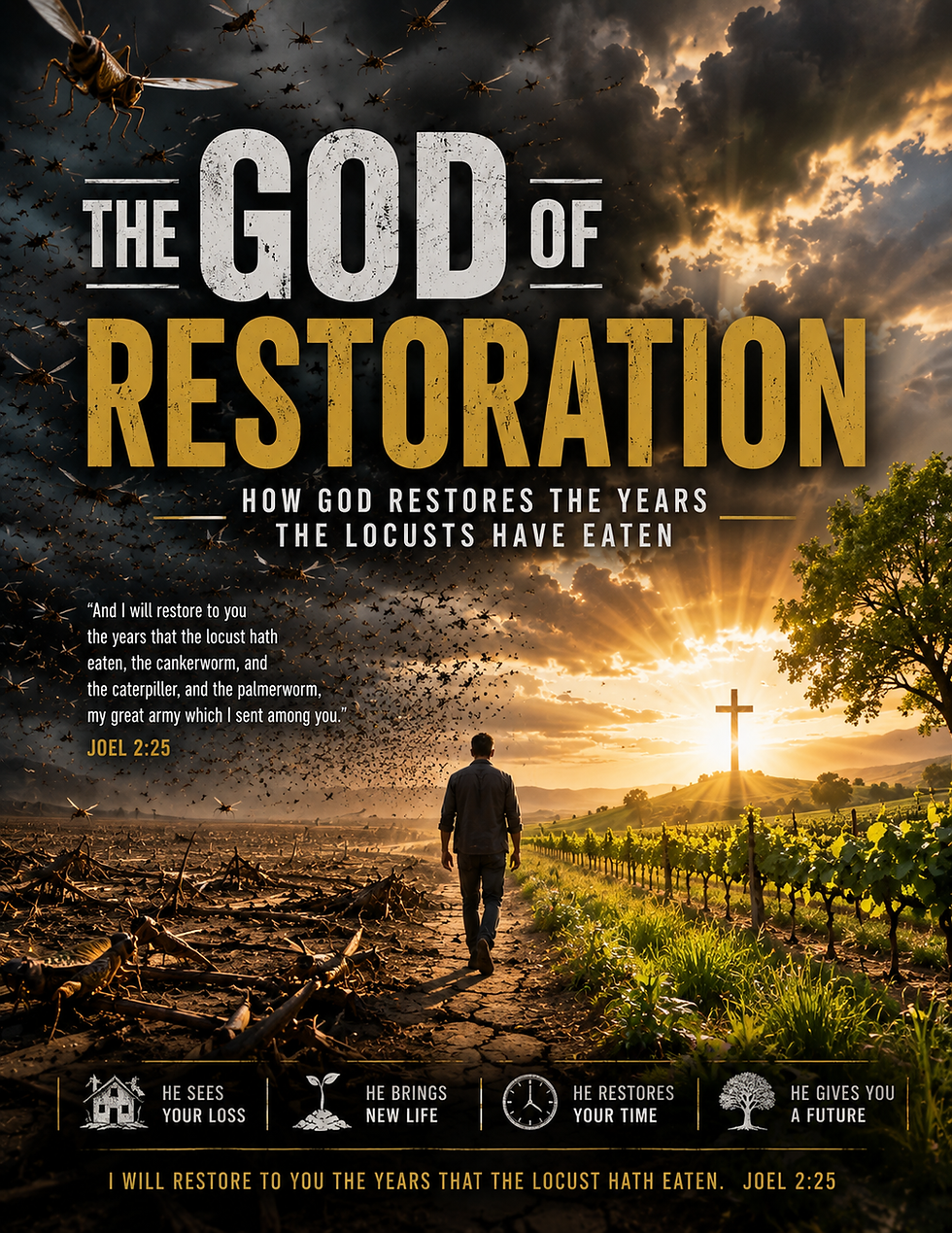
How God Restores the Years the Locusts Have Eaten
Scripture Reference: Joel 2:25–26; 1 Peter 1:6–7
“And I will restore to you the years that the locust hath eaten, the cankerworm, and the caterpillar, and the palmerworm, my great army which I sent among you. And ye shall eat in plenty, and be satisfied, and praise the name of the Lord your God, that hath dealt wondrously with you: and my people shall never be ashamed."
“Wherein ye greatly rejoice, though now for a season, if need be, ye are in heaviness through manifold temptations: That the trial of your faith, being much more precious than of gold that perisheth, though it be tried with fire, might be found unto praise and honour and glory at the appearing of Jesus Christ.”
Introduction –The backdrop behind Joel’s message of Restoration
The book of Joel was written during one of the darkest national crises in the history of Judah. The land had been devastated by an overwhelming locust invasion unlike anything the people had ever seen before. Joel describes wave after wave of destruction sweeping across the nation until virtually nothing remained.
Fields were ruined.
Crops were destroyed.
Fruit trees were stripped bare.
Vineyards were empty.
The grain offerings in the temple ceased because there was no grain left to offer.
Joel described the devastation in terrifying detail:
“That which the palmerworm hath left hath the locust eaten…” Joel 1:4
This was more than an agricultural problem. It was an economiccollapse, a national emergency, and a spiritual wake-up call all at once.
Many scholars believe the devastation may have lasted multiple years. Locust invasions in the ancient world were catastrophic. These insects would descend upon the land in enormous swarms darkening the sky, consuming every green thing in sight. Entire harvests could disappear within hours. Once the crops were gone, famine followed. Livestock suffered. Families starved. Fear spread - Everywhere.
But Joel saw something deeper than a natural disaster.
Under the inspiration of God, Joel understood that the locust plague was also a form of divine judgment meant to awaken the people spiritually. Judah had become spiritually cold and complacent. Worship had become outward ritual while hearts drifted far from God. Sin, pride, compromise, and rebellion had spread through the nation.
So God shook the nation.
Joel interpreted the locust invasion as a warning that an even greater judgment would eventually come unless the people truly repented and returned to the Lord. That is why Joel repeatedly called the people to humble themselves before God:
“TURN ye even to me with all your heart…”— Joel 2:12
The message of Joel is deeply relevant to prison life because many prisoners understand exactly what it feels like to watch the “locusts” destroy years of life.
Many inmates know what it feels like to lose:
freedom,
family,
opportunities,
marriages,
health,
peace,
dignity,
Some men entered prison after years of addiction. Others after violence, crime, anger, gangs, lust, pride, or rebellion. Many live with crushing regret over wasted years and painful consequences.
Like Judah in Joel’s day, they look back over devastation and think
“How did my life end up HERE?”
That is what makes Joel 2:25 one of the most hope-filled promises in all the Bible. Right in the middle of judgment, devastation, and loss, God spoke these astonishing words
“I will restore to you the years that the locust hath eaten.”
What an incredible promise.
God did not promise that the people would erase the past.
He did not pretend sin had no consequences.
He did not minimize the devastation.
But He did promise restoration to repentant people.
Joel’s message is ultimately not a message of destruction — It is a message of mercy after repentance. The same God who judges sin also delights in restoring broken sinners
This restoration included:
renewed fellowship with God,
renewed spiritual blessing,
renewed fruitfulness,
renewed joy,
and renewed hope.
Joel promised that the barren fields would once again overflow with grain, wine, and oil. The drought would end. The rains would return. The people who once sat ashamed in devastation would again praise the Lord for His goodness.
Most importantly, God promised His presence among them:
“Ye shall know that I AM in the midst of Israel…”— Joel 2:27
That is the true heart of restoration. Not merely restored circumstances - but restored fellowship with God.
And that is still the greatest restoration any sinner can ever experience today. Many prisoners cannot go backward and undo the past. None of us can.
But through Jesus Christ, God can redeem ruined lives and bring eternal purpose out of years that appeared wasted forever.
That is the hope of Joel 2 - The God of judgment is also the God of restoration.
Main Point #1 –God allows locust seasons to wake us up Spiritually
The book of Joel begins with devastation.
The land had been stripped bare by wave after wave of locusts. Crops were destroyed. Vineyards were ruined. The fields were empty. Famine spread across the land. The economy collapsed. Families suffered. Fear and grief filled the nation.
Joel described it this way:
“That which the palmerworm hath left hath the locust eaten” Joel 1:4
The people of Judah were living carelessly and complacently. Their worship had become cold and formal. Sin had quietly spread through the nation. They still carried out religious duties outwardly, but their HEARTS had drifted far from God.
So God allowed devastation to come.
The locust invasion was not merely an environmental disaster. Joel interpreted it as divine warning — a wake-up call from God. Sometimes God allows painful seasons because He loves us too much to leave us spiritually asleep.
Many prisoners understand this truth deeply. For some men, prison became the first time they seriously thought about:
eternity,
judgment,
repentance,
salvation,
or God.
Before prison there may have been:
addiction,
crime,
pride,
rebellion,
selfish living,
lust,
violence,
or spiritual indifference.
Life had revolved around pleasure, money, gangs, drugs, anger, or self-will.
Then suddenly the locusts came.
Everything collapsed.
Freedom disappeared.
Families broke apart.
Careers ended.
Reputations were destroyed.
Dreams vanished.
And in that devastation, many finally heard the voice of God. This is a painful truth, but it is a merciful truth. God often uses brokenness to awaken people spiritually.
C.S. Lewis famously said:
“God whispers to us in our pleasures, speaks in our conscience, but shouts in our pains.”
Sometimes the very thing we hate becomes the instrument God uses to save us.
The prodigal son is a perfect example.
When he wasted his inheritance in reckless living, he ended up feeding pigs in a famine. Only then did he finally “come to himself” and return to his father.
Likewise, many people never truly seek Christ until the locusts destroy the false securities they trusted in.
Joel’s message was not: “You are too ruined for God.
His message was: “RETURN unto the Lord.
That remains God’s message today. No matter how much damage sin has caused, God still calls sinners to repentance and restoration.
Main Point #2 – God restores what sin and suffering destroyed
Joel 2:25 contains one of the most astonishing promises in Scripture:
“I will restore to you the years that the locust hath eaten."
Think about how impossible that sounds.
Money can sometimes be recovered.
Homes can be rebuilt.
Relationships can occasionally heal.
But TIME? –Lost years never come back.
Yet God specializes in doing what human beings cannot do. This promise does not mean God rewinds history or erases consequences completely. Some earthly scars remain. Some opportunities never return exactly as before.
But God can redeem ruined lives so powerfully that His grace outweighs the devastation.
That is restoration.
The years the locusts had eaten represented:
wasted years,
sinful years,
painful years,
rebellious years,
fruitless years,
and broken years
Many prisoners understand the agony of wasted years.
Some look back with crushing regret:
“I wasted my youth.”
“I destroyed my family.”
“I ruined my future.”
“I hurt the people I loved.”
“I traded decades for sin.”
Satan loves to trap people in hopeless regret.
He whispers:
“You’re ruined.”
“Your life is over.”
“God can never use you now.”
But Joel 2:25 stands against that despair.
God restored:
Peter after denial,
David after failure,
Jonah after rebellion,
Mark after quitting,
and Paul after persecuting Christians
No sinner is beyond the reach of restoring grace.
Billy Graham once said:
“God specializes in giving people a fresh start."
Some of the greatest servants of God were once deeply broken people.
The apostle Paul once imprisoned Christians before becoming a
preacher of the gospel.
John Newton once trafficked slaves before writing “Amazing Grace”
God delights in displaying His mercy through redeemed sinners.
Your failures may become part of your testimony.
Your pain may become part of your ministry.
Your brokenness may become the very place where God’s grace
shines brightest.
Main Point #3 – God restores us first spiritually before He restores us outwardly
One of the most important truths in Joel is this: God cared about more than crops.
The outward restoration pointed toward something deeper – restored fellowship with God.
Joel repeatedly called the people to repentance:
“TURN ye even to me with all your heart” — Joel 2:12
God was not merely interested in fixing their circumstances while leaving their hearts unchanged. He wanted spiritual restoration. That is still true today.
Many people want God to change their circumstances but do not want God to change their hearts.
They want:
freedom without repentance,
blessing without surrender,
peace without holiness,
and restoration without obedience.
But God’s greatest priority is always THE SOUL.
Sometimes God allows outward hardship because inward transformation matters more.
Prison often becomes a place where God strips away false identities.
Outside prison, many people hide behind:
money,
popularity,
drugs,
relationships,
success,
or pride.
But prison exposes reality.
And sometimes, for the very first time, a man becomes honest before God.
David prayed:
“Create in me a clean heart, O God…” — Psalm 51:10
That is true restoration.
The greatest miracle is not merely getting your life back together outwardly.
The greatest miracle is becoming right with God.
Charles Spurgeon said:
“It is better to be broken by God than destroyed by sin.”
Many prisoners entered prison spiritually dead, but became spiritually alive through Christ.
They lost freedom but found salvation.
They lost comfort but found peace with God.
They lost worldly success but gained eternal life.
That is why some believers can honestly say:
“Prison saved my life spiritually.”
Over the years, what a powerful privilege it has been to hear the testimonies of many lifers who now give all the glory to God. Many openly admit that had they never caught their case, they would have continued down a path of violence, addiction, crime, recklessness, and rebellion until they eventually ended up taking “a dirt nap.”
Some recognize that prison walls became the very place where God stopped them before total destruction consumed their lives. What once seemed like the absolute ruin of their future became the unexpected place where the Lord broke their pride, awakened their conscience, humbled their hearts, and drew them to Jesus Christ.
Many of these men lost their freedom outwardly, yet found true freedom inwardly through the gospel. And today, with tears in their eyes, they can honestly testify that while prison became the darkest chapter of their earthly story, it was also the place where God began restoring the years the locusts had eaten.
Not because prison itself is good — but because God brings good out of suffering.
Joel reminds us that God restores repentant sinners because He is merciful.
He is not eager to destroy. He delights to forgive.
Main Point #4 – God can still produce fruit in the years you have left
One of the enemy’s greatest lies is:
“It’s too late for you now.”
Many prisoners feel disqualified because of:
age,
mistakes,
addiction,
criminal history,
lost opportunities,
or wasted time.
But the Bible repeatedly shows God using broken people late in life.
Moses was eighty years old when God called him.
The thief on the cross found mercy in his final hours.
Paul spent years persecuting Christians before becoming an apostle.
God is not limited by your past.
Joel promised abundant harvest after devastation:
“The floors shall be full of wheat” – Joel 2:24
God can produce spiritual fruit even after years of destruction.
A man may never recover every earthly opportunity he lost — but he can still become fruitful for Christ.
Some prisoners become:
prayer warriors,
encouragers,
Bible teachers,
disciplers,
witnesses,
or spiritual fathers to younger believers.
God can use a surrendered life at any stage.
John Piper said:
“God is always doing ten thousand things in your life, and you may be aware of three of them.”
Even now, God may be preparing YOU for future usefulness.
The years ahead do not need to be empty years.
You may not control your sentence.
You may not control your circumstances.
But by God’s grace, you can still:
grow spiritually,
serve faithfully,
love deeply,
pray powerfully,
and glorify Christ.
The locusts do not get the final word.
God does.
Prison Application –When prison feels like the locust years
For many inmates, prison represents the visible evidence of the years the locusts have eaten. Men often sit alone in their cells remembering:
destroyed marriages,
abandoned children,
addictions,
violence,
wasted opportunities,
broken trust,
and years that can never be relived.
The weight of those memories can become almost unbearable.
About five years ago, I visited a young man who is now a professing Christian. Before God began changing his life, the guilt, regret,hopelessness, and devastation from his past had driven him into such deep despair that he attempted to take his own life three separate times.
During one visit, he pulled back his shirt and showed me a gruesome ten-inch vertical scar running down his chest where he had taken a knife to himself in utter brokenness.
As he spoke, tears filled his eyes while he reflected on the wreckage sin had left behind — shattered relationships, wasted years, destroyed trust, and the overwhelming feeling that his life had become beyond repair. Yet today, by the grace of God, that same man testifies that Christ met him in the darkness of his prison cell and gave him a reason to live again.
His scars remain as painful reminders of where sin once brought him, but they also stand as living testimony that God still restores broken sinners who cry out to Him for mercy.
REGRET can become overwhelming.
Some prisoners replay the same memories daily:
“If only I had walked away."
“If only I had listened.”
“If only I had chosen differently.”
But constant regret can eventually become spiritual PARALYSIS.
Joel’s message offers hope to broken people: God is still able to restore
Not always by removing consequences immediately — but by redeeming what remains.
A prisoner may not recover every earthly loss. But he can still become spiritually transformed.
Some of the strongest Christians in history suffered imprisonment. The apostle Paul wrote letters from prison that still strengthen millions today.
God can use prison years for eternal purposes. Many prisoners discover:
deeper prayer,
stronger faith,
hunger for Scripture,
repentance,
humility,
and dependence upon Christ.
Those things often grow best in suffering.
Prison can either HARDEN the heart or SOFTEN it.
Some become bitter.
Others become broken before God.
And brokenness before God is often where restoration begins.
The greatest tragedy is not prison itself.
The greatest tragedy is wasting prison spiritually.
A man may lose freedom temporarily and still gain eternal life.
God can take shattered lives and rebuild them for His glory.
That is the message of Joel 2
Final Thought – The years were not wasted if they brought you to Christ
Joel’s promise is one of the tenderest promises in all of Scripture:
“I will restore to you the years that the locust hath eaten.”
Many believers carry deep sorrow over wasted years. Years lost to:
addiction,
rebellion,
lust,
selfishness,
anger,
crime,
spiritual apathy,
or unbelief.
And the truth is painful:
Some earthly losses cannot fully be undone in this life.
But God’s grace is greater than our ruin.
The cross proves that.
When Jesus Christ died upon the cross, He bore the judgment our
sins deserved. Isaiah said:
“He was cut off out of the land of the living."
Christ entered our devastation.
He entered our sorrow.
He entered our judgment.
Our locusts swarmed over Him.
Then He rose again in victory.
Because of Christ:
sinners can be forgiven,
broken lives can be restored,
guilty consciences can be cleansed,
and ruined years can still bear eternal fruit.
The enemy says: “Your story is FINISHED."
God says: “I am still writing your story.”
The years behind you may contain failure.
But the years ahead can still contain faithfulness.
One day in eternity, believers will fully see how God used even painful years for eternal purposes.
Romans 8:28 will finally become perfectly clear.
Not one sorrow was meaningless.
Not one tear was wasted.
Not one broken season escaped God’s sovereign hand.
R.C. Sproul once said:
“There are no maverick molecules if God is sovereign.”
Even the locust years were under God’s control.
And somehow, through grace beyond human understanding, God
can bring beauty from ashes and hope from ruin.
That is the miracle of restoration.
Reflection Questions
1. What “locust years” in my life do I regret the most?
2. Have painful consequences helped awaken me spiritually?
3. Am I truly repentant, or only sorry for consequences?
4. In what ways has God already begun restoring my life
spiritually?
5. How can I use my remaining years for Christ instead of
dwelling only on the past?
6. What areas of bitterness or shame do I still need to surrender to
God?
7. How does the cross of Christ give hope even after years of
failure?
Closing Prayer
Heavenly Father,
Thank You for being the God of restoration. Thank You that no life
is too broken, no sinner too ruined, and no past too damaged for
Your grace. We confess the years we wasted in sin, rebellion,
selfishness, and spiritual neglect. Forgive us, Lord, for the years the
locusts have eaten.
Help us not live trapped in regret and shame. Teach us to believe
that through Jesus Christ You can redeem even broken lives and
painful seasons. Restore our hearts, restore our minds, and restore
our fellowship with You.
Use even our suffering and prison years for eternal good. Give us
humble and repentant hearts. Help us bear fruit for Christ in the25
years we have remaining. And remind us daily that Your mercy is
greater than our failures.
Thank You for the cross, for forgiveness, and for the hope of eternal
life through Jesus Christ.
In Jesus’ name, Amen.
From: Fight the Good Fight of Faith / Life Journal: bv Gregg Harris


Comments